The ‘Pacesetters’ are 4x more likely to move AI pilots into production, and 40% more likely to report measurable value from AI based in CISCO Report!
CISCO REPORT
Cisco (NASDAQ: CSCO), the worldwide leader in networking and security, today released the results from the third annual Cisco AI Readiness Index.
CISCO AI READINESS INDEX
A small but consistent group of companies — the ‘Pacesetters,’ about 16% of organizations surveyed in Malaysia, and 13% globally, for the last three years — outperform their peers across every measure of AI value, captured for the first time in Cisco’s global study of over 8,000 AI leaders across 30 markets and 26 industries.

ADVANTAGE INDICATES
The Pacesetters’ sustained advantage indicates a new form of resilience: a disciplined, system-level approach that balances strategic drivers with the data and infrastructure needed to keep pace with AI’s
accelerating evolution. They’re already architecting for the future with 98% designing their networks for
the growth, scale and complexity of AI compared to 49% in Malaysia.
COMBINATION FORESIGHT & FOUNDATION
The combination of foresight and foundation is delivering real, tangible results at a time when two major forces are starting to reshape the landscape: AI agents, which raise the bar for scale, security, and
governance; and AI Infrastructure Debt, the early warning signs of hidden bottlenecks that threaten to
erode long-term value.
“This year’s Cisco AI Readiness Index makes one thing clear: readiness leads to value. Across the board, we are seeing that AI-ready organizations— the Pacesetters in our research — prove this. They’re four times more likely to move pilots into production and 40% more likely to realize measurable value. As organizations now move toward deploying AI agents, their success depends on their readiness, discipline, and action.”
-said Chee Kheong Lee, Managing Director, Cisco Malaysia.
THE PACESETTER PROFILE:
Readiness as competitive advantage Cisco’s research outlines a consistent pattern among these leaders delivering real returns.
●AI PART OF BUSINESS, NOT A SIDE PROJECT
Nearly all Pacesetters (99%) have a defined AI roadmap (vs 64% in Malaysia) and 91% (vs 38% in Malaysia) have a change-management plan. Budgets match intent, with 79% making AI the top investment priority (vs 26% in Malaysia) and 96% with short- and long-term funding strategies (vs 56% in Malaysia).
● BUILD INFRASTRUCTURE THAT’S READY TO GROW
They architect for the always-on AI era. 71% of Pacesetters say their networks are fully flexible and can scale instantly for any AI project (vs 18% in Malaysia), and 77% are investing in new data-center capacity within the next 12 months (vs 39% in Malaysia).
● MOVE PILOTS INTO PRODUCTION
62% have a mature, repeatable innovation process for generating and scaling AI use cases (vs 13% overall in Malaysia), and three-quarters (77%) have already finalized those use cases (vs 19% in Malaysia).
● MEASURE WHAT MATTERS
95% track the impact of their AI investments — nearly three times higher than others — and 71% are confident their use cases will generate new revenue streams, double the overall local average in Malaysia.
● TURN SECURITY INTO STRENGTH
87% are highly aware of AI-specific threats (vs 49% overall in Malaysia), 62% integrate AI into their security and identity systems (vs 36% in Malaysia), and 75% are fully equipped to control and secure AI agents (vs 46% in Malaysia).
Trust is part of the Pacesetters’ value equation. Pacesetters achieve more widespread results than their peers because of this approach: 90% report gains in profitability, productivity, and innovation, compared with 65% overall in Malaysia.
AI AGENTS: AMBITION OUTPACING READINESS
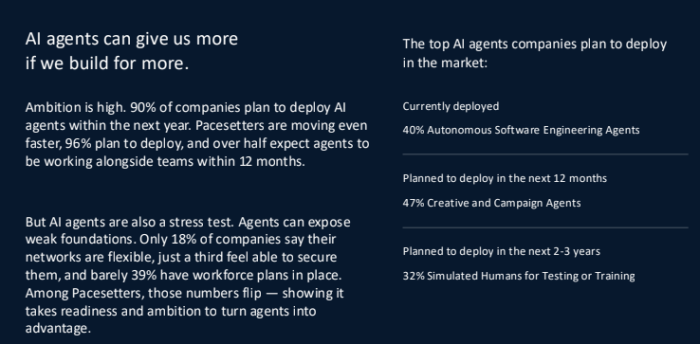
The Index shows 90% of organizations in Malaysia plan to deploy AI agents, and nearly 36% expect them to work alongside employees in the next year. But for majority of these companies, AI agents are exposing weak foundations — systems that can barely handle reactive, task-based AI.
Let alone AI systems that act autonomously, and learn continuously. 32% of respondents say their networks can’t scale for complexity or data volume and just 18% describe their networks as flexible or adaptable. Pacesetters are again the exception. Their disciplined, system-level approach has already helped lay the foundations they will need to scale.
AI INFRASTURCTURE DEBT: THE EMERGING DRAG ON VALUE
The report introduces a new concept — AI Infrastructure Debt — the modern evolution of technical anddigital debt that once held back digital transformation. It’s the silent accumulation of compromises, deferred upgrades, and underfunded architecture that erodes the value of AI over time.

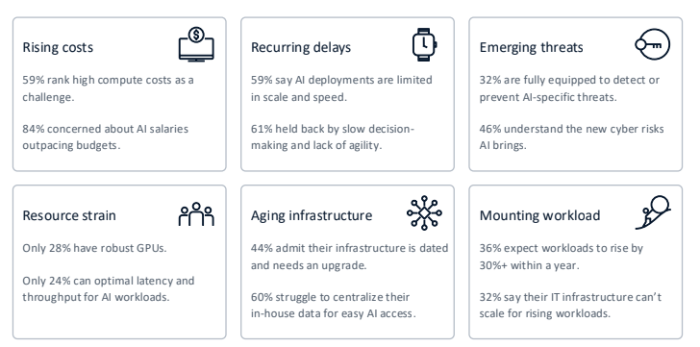
Some early warning signs are already visible: 36% expect workloads to rise by over 30% within three years, 60% struggle to centralize data, only 28% have robust GPU capacity and fewer than one in three can detect or prevent AI-specific threats.
These early warning signs point to a gap between AI ambition and operational readiness. But when the systems that power AI aren’t secure, the debt can increase risk. Pacesetters aren’t immune, but their foresight, governance, and investment help discipline position them to avoid problems compounding into more costly risks.